
 en
 Български
 Română
Population size and short-term trend
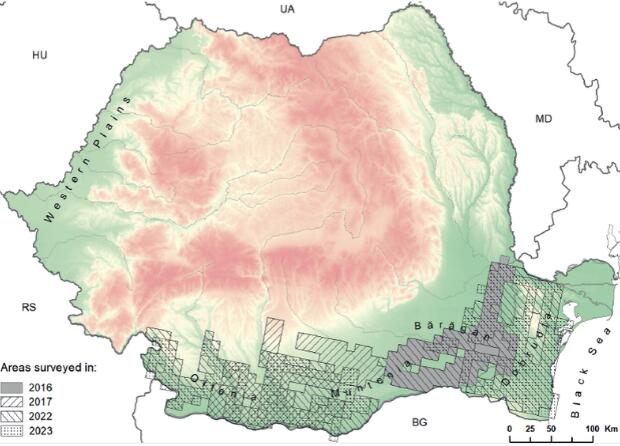
During the period 2016–2023, the field work covered a study area of 28,065 km² in the Romanian Plain (Oltenia and Muntenia) and in Dobrogea. Based on the collected data, the specialists conducted a series of analyses, using criteria regarding nesting behavior, the territories in the country preferred by the Danube falcons for nesting, and demographic indices.
Field monitoring results
Evolution of nesting pairs: In Dobrogea, the number of occupied territories increased from 3–4 pairs recorded in the period 2017–2021, to 5 pairs in 2022 and to 7 pairs in 2023.
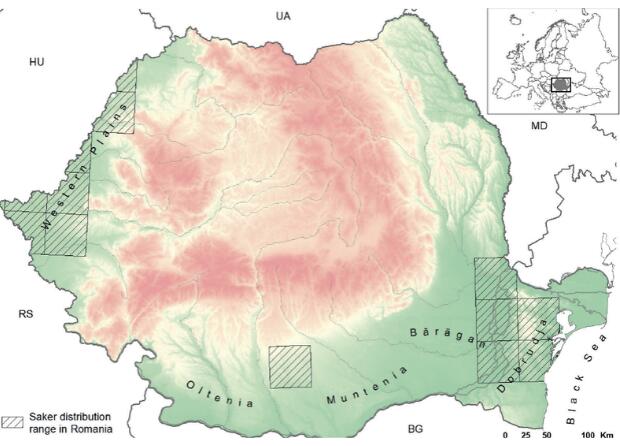
Geographic distribution: Dobrogea represents the core of the population in the south of the country. Outside this region, only isolated nesting attempts have been observed (e.g. a failed attempt in Teleorman County in 2017, in an old crow nest) and temporary presences of non-nesting or immature individuals in Dolj and Olt counties.
National estimate for southern Romania: The population in southern Romania was estimated at 7–9 breeding pairs in 2023.
Demographic parameters (Dobrogea):
2022: Reproductive success of 0.8 (ratio of successful nestings to total attempts) and an average of 3.25 fledglings per pair (13 chicks in total).
2023: Reproductive success of 0.86 and an average of 2.33 fledglings per pair (14 chicks in total).
Despite the observed short-term numerical increase, the authors mention that this trend may also be influenced by the intensification of the monitoring effort in 2022 and 2023, the field monitoring in Dobrogea being carried out within the project Ensuring the recovery of the population of the Danube falcon, an endangered species in Bulgaria and southern Romania (LIFE20 NAT/BG/001162) . According to IUCN criteria, the subpopulation of the Danube falcon in Dobrogea falls into the Critically Endangered category at the regional level, with less than 50 mature individuals.
The transition to artificial nests
The Danube falcon does not build its own nest, but uses structures built by other bird species or may nest on artificial platforms. The study highlights a significant change in nesting site choice in Dobrogea
In 2012, all 4 known pairs were nesting in old natural maned crow nests.
During 2012–2013, as part of a LIFE project, 31 artificial metal nests were installed.
Between 2018 and 2021, all identified nesting took place exclusively in artificial nests.
In 2022 and 2023, sporadic reoccupation of natural nests of the greater buzzard was also observed.
The use of artificial platforms provides the Danube falcons, as well as other species, such as kestrels or buzzards, with safer nesting spaces protected from adverse weather conditions.
Habitat preferences
Habitat analysis within a radius of 4 km, 7.8 km and 10 km around the nests showed the following ecological characteristics:
Agricultural land: occupied nests had significantly larger areas of agricultural land within a 10 km radius compared to unoccupied nests. This is explained by the availability of food, especially pigeons and other species associated with cultivated areas.
meadows and pastures: although all occupied nests were surrounded by over 2,000 ha of meadows within a 10 km radius, the immediate proximity of meadows to the nest did not prove to be a direct limiting factor in nest site selection.
distance from settlements: the Danube falcons preferred nests located further away from settlements and with smaller areas of surrounding village hearths, avoiding human disturbance.
forested area: occupied territories had reduced forest cover compared to unoccupied spaces.
Relationship with wind farms
Considering the development of wind infrastructure in Dobrogea, this study assessed the impact of wind turbines on nest distribution. The main findings were the following:
minimum distance: no nest was occupied if it was located less than 2 km from the nearest functional wind turbine.
turbine density: the number of wind turbines within a radius of up to 10 km was significantly lower around occupied nests.
tolerance threshold: in the territories occupied by the Danube falcons, wind farms occupied less than 6% of the total area within a radius of up to 20 km around the nest.
The results indicate that the Danube falcons avoid nesting near wind turbines. This avoidance may lead to the loss or fragmentation of suitable foraging and nesting habitats.
Conclusions of the study for the future of the Danube falcons
The population of the Danube falcon in southern Romania continues to remain at a low level. For the survival of this Critically Endangered species , continuous protection measures are necessary, of particular importance being the maintenance and monitoring of the network of artificial nests on power lines, the protection of open feeding areas and populations of prey species (such as the kestrel) and the rigorous planning of future wind projects, by avoiding the location of turbines in nesting areas and corridors used by Danube falcons.
The scientific article The Saker Falcon (Falco cherrug) in Southern Romania: population, trend and habitat requirements in the breeding season was published in the journal Ornis Hungarica and can be consulted here .