
 en
en  Български
 Română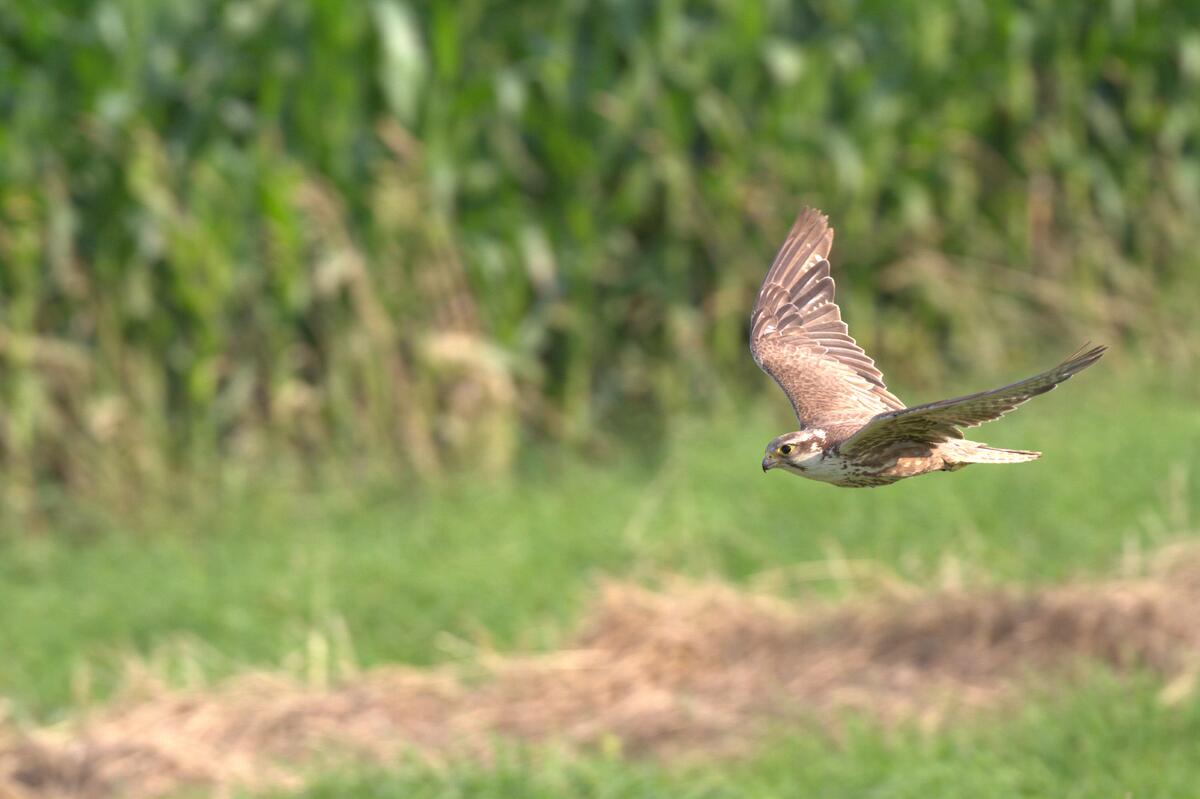
Photo: Peter Csonka
A new scientific study provides a detailed look at how a pair of Saker Falcons successfully raised five chicks – a remarkable achievement for the recovering population of the species in Bulgaria.
The study was published in the scientific journal Raptor Journal and was conducted as part of the “Life for Falcons” project. The team of authors includes experts from the Bulgarian Society for the Protection of Birds (BSPB), Green Balkans and the National Museum of Natural History at the Bulgarian Academy of Sciences.
The Saker Falcon disappeared as a breeding species from Bulgaria at the end of the 20th century. Following the launch of the Green Balkans’ restoration programme in 2011, 160 young birds have been released into the wild, and the first successful breeding was recorded in 2017. Today, six breeding territories are occupied in the country – three by pairs and three by single territorial males.
At the centre of the new study is a pair of Saker Falcons that successfully raised five chicks in 2025. Both parents are birds that hatched at the Wildlife Rescue Centre and were released into the wild as juveniles as part of the Green Balkans Programme – the male in 2015 and the female in 2019. They settled approximately 40 kilometres from the place where they were released and have now bred successfully for four consecutive years.
To investigate the division of parental care, feeding and the behaviour of the chicks, the researchers observed the nest for 14 days, for a total of nearly 91 hours. The observations were carried out from a hide approximately 40 metres from the nest, without disturbing the birds.
During this period, 56 food deliveries were recorded. The results show a clear division of roles between the two parents. The male provided most of the prey – in 72% of the cases. The female hunted considerably less often but took primary responsibility for feeding the offspring. She fed the chicks in 85% of the observed cases.
The researchers also recorded impressive aerial prey transfers. The male would usually announce his approach with loud calls from more than a kilometre away. The female would fly out to meet him and sometimes take the food directly in mid-air.
The European souslik – an essential food source for the Saker Falcon
The study confirms the crucial importance of the European souslik for the recovery of the Saker Falcon in Bulgaria. It accounted for 85% of the food provided by the male and 92% of that brought by the female.
Just two kilometres from the nest are grasslands with well-preserved and abundant souslik colonies. The proximity of this rich food resource is likely one of the main reasons why the pair managed to raise a record five chicks.
Based on the observed frequency of food deliveries, the researchers estimate that the pair and their offspring may have consumed approximately 600 sousliks over the entire breeding season. This clearly demonstrates how important grasslands with abundant souslik colonies are for Saker Falcon breeding territories.
The decline and disappearance of these grasslands is a serious conservation problem. Therefore, protecting and restoring their colonies is directly linked to the future of the Saker Falcon in Bulgaria.
The article “Foraging and parental behaviour of a saker falcon pair raising five fledglings” has been published in Raptor Journal. The study was carried out as part of the “Life for Falcons” project, co-financed by the European Union’s LIFE Programme. The scientific publication is available via DOI: 10.2478/srj-2026-0008.